Rattan, seagrass or bamboo: three fibres, three kinds of light
Rattan bends and can be woven open, so light escapes sideways. Seagrass weaves tight and sends light down. Bamboo is stiff and suits geometric shades.
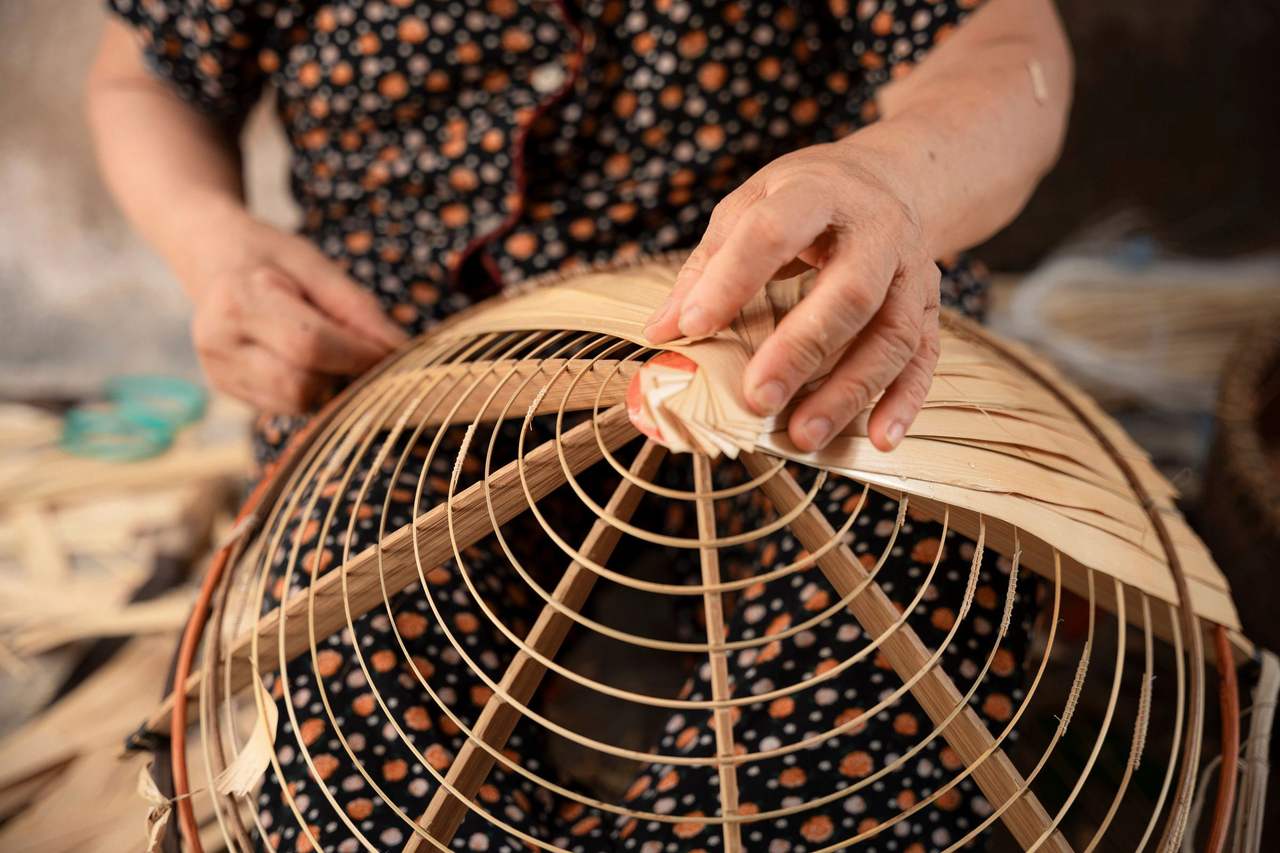
Rattan, seagrass and bamboo give you three different kinds of light. Rattan is pliable, so it can be woven open: light slips out sideways through the gaps and draws a pattern on the wall. Seagrass is soft and weaves tight: light is pushed down into one round pool under the lamp. Bamboo is straight and stiff, which suits shades with flat sides and corners. Pick the fibre for the job. To light a whole room, rattan. To light one spot, seagrass. At our workshop rattan is used on Hạ Chí (Summer Solstice), Đông Chí (Winter Solstice) and Xuân Phân (Spring Equinox); seagrass on Lập Thu (Start of Autumn) and Tiểu Mãn (Grain Buds). We do not currently weave bamboo.
Shops in Vietnam lump all three together as “đèn mây tre đan”, rattan and bamboo lamps. Pick up one shade of each and the difference is obvious. This is that difference, from the person doing the weaving.
How the three fibres differ
Rattan is the stem of climbing palms. Wikipedia counts roughly 600 species in the subfamily Calamoideae. Unlike bamboo, the stem is solid, not hollow. The outer layers are pared into strips for weaving and the core is used like timber for furniture frames. Thin strips are supple and follow a round mould without snapping.
Seagrass, as the trade calls it in English, is what we call cói: a sedge grown on coastal and riverside alluvial land with brackish water. The Vietnamese Wikipedia entry names two main cultivated species, Cyperus tegetiformis and Cyperus corymbosus, grown in the north from Quảng Ninh to Thanh Hóa and along the south-central coast. You know it from sleeping mats, bags and hats. The stems are soft and can be twisted into a thick cord and woven tight.
Bamboo is hollow, with a straight, stiff grain. Split into flat slats, it holds straight edges and right angles. Bend it hard into a curve and it tends to split.
| Rattan | Seagrass (cói) | Bamboo | |
|---|---|---|---|
| The fibre | Solid, supple when split thin | A sedge, soft, twisted into thick cord | Hollow, stiff, straight slats |
| Weaves well as | Open, closed or square weave | Tight or coarse weave | Flat slats, boxy forms |
| Light through the shade | Out sideways, patterned | Down, into one round pool | Through the slots, in straight lines |
| Shapes it suits | Round, bell | Round, drum | Boxy, angular |
| Our lamps | Hạ Chí, Đông Chí, Xuân Phân | Lập Thu, Tiểu Mãn | None |
The last three rows are what we see at the workshop, not measurements.
One wall, three kinds of light
We often hang shades one after another in front of the same white wall so visitors can compare. This is what you see with a 2700K, 6 W bulb.
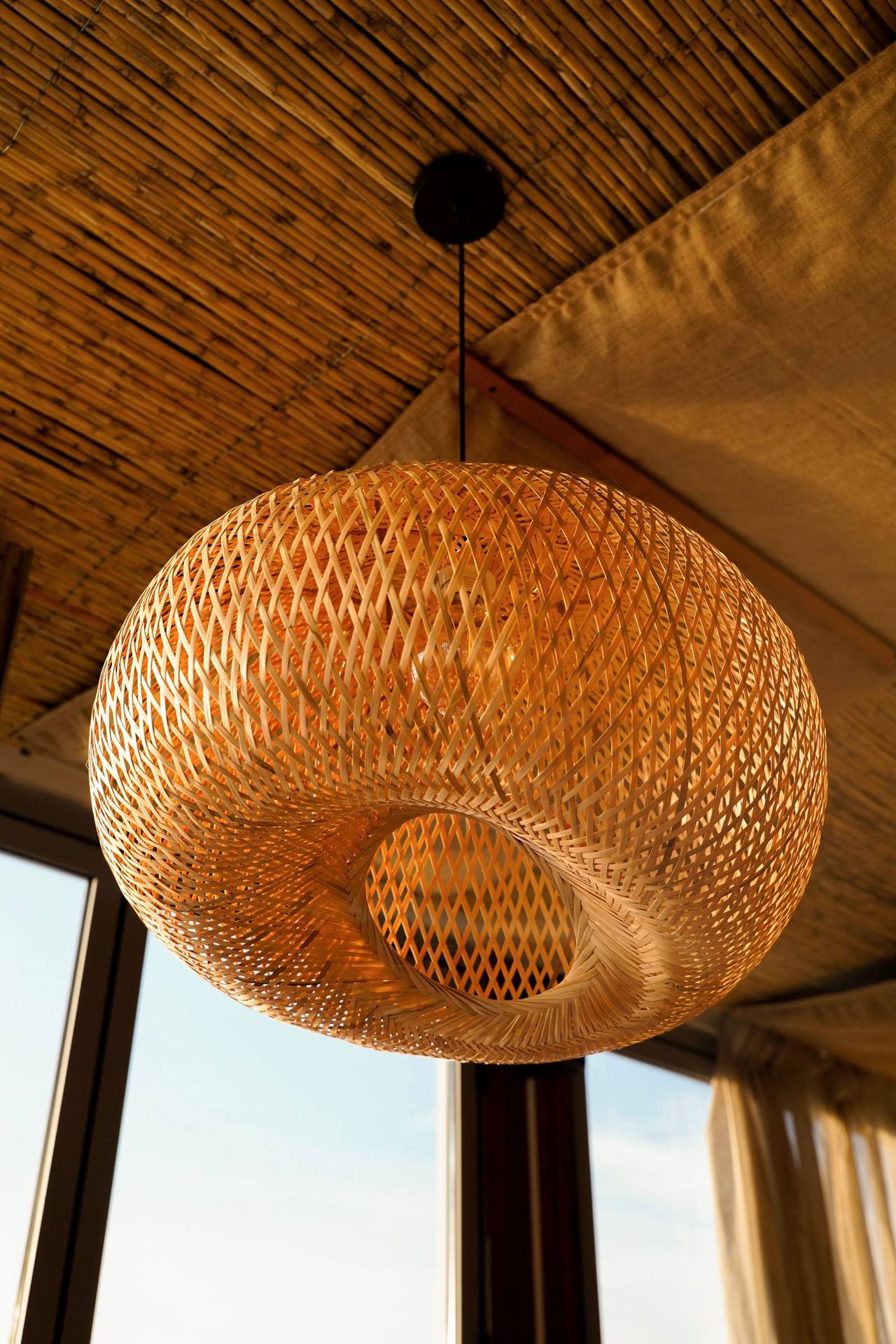
The open-weave Hạ Chí, 45 cm across: the wall about a metre away carries the pattern of the weave, soft at the edges and sharper close in. The ceiling lights up too. A living room feels larger because the light goes everywhere.
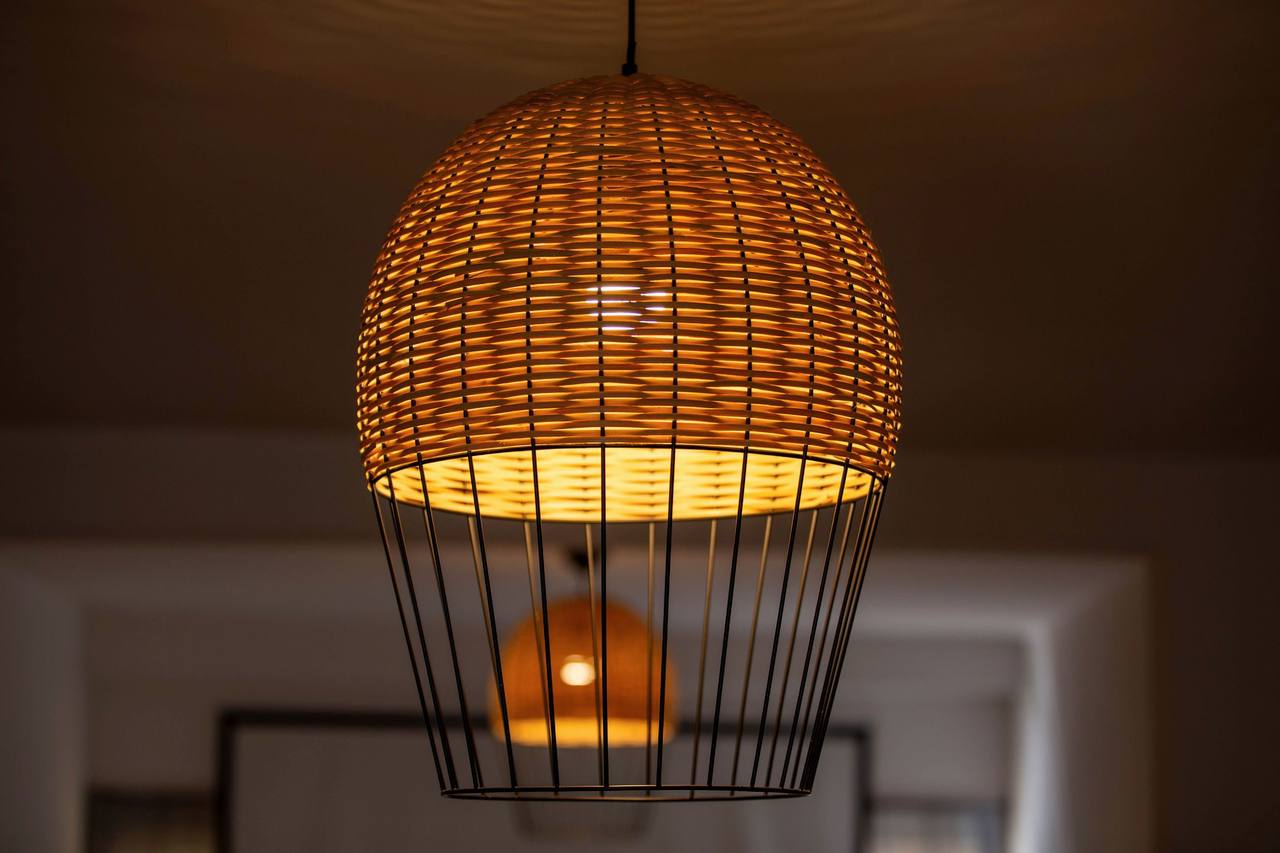
The tight seagrass Lập Thu, 32 cm: the wall stays almost dark. Below the lamp there is one round pool, enough for a book or two coffee cups. The shade itself never glares.
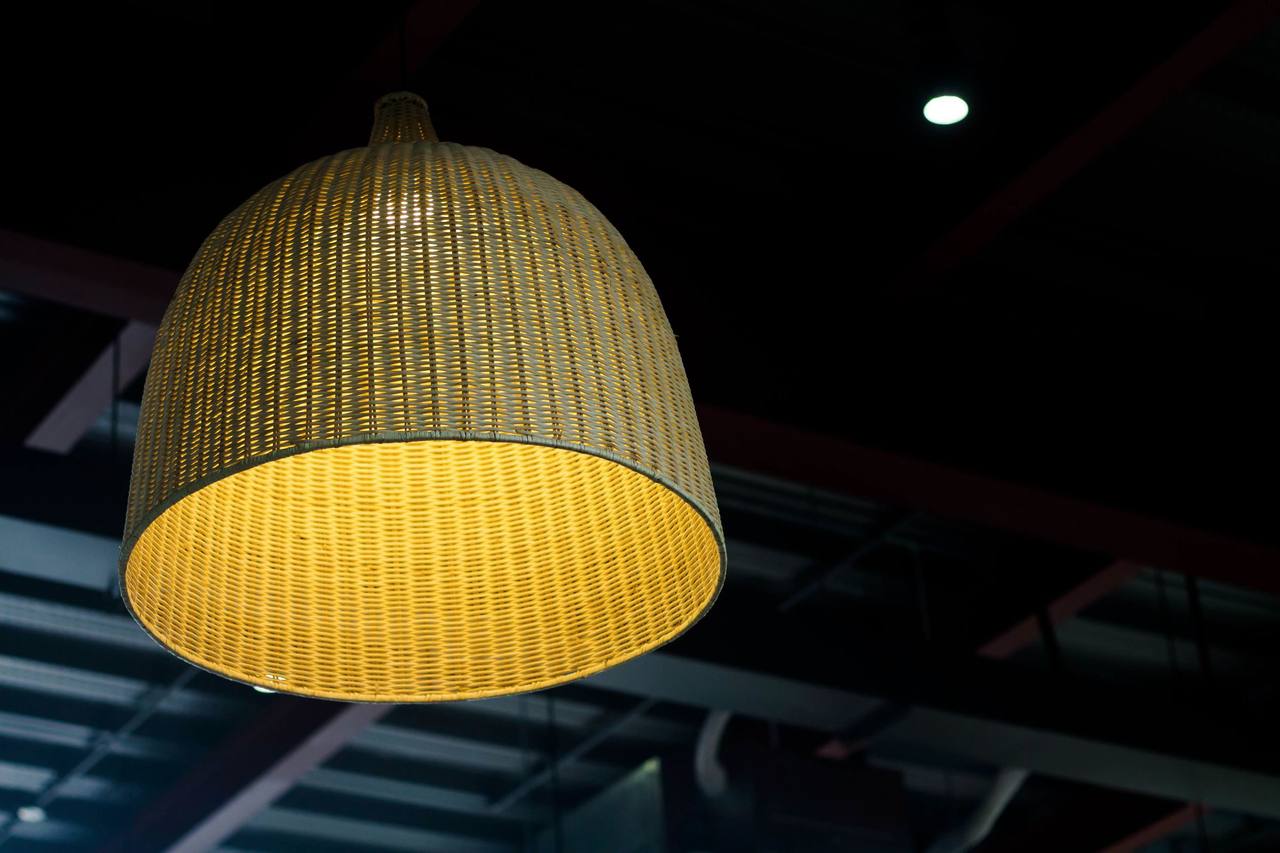
The Đông Chí bell sits in between: closed rattan with one open band around the middle. Light leaves as a horizontal band and does not shine into the eyes of someone lying down. That is why it works by a bed or in a corridor.
Flat bamboo slats throw straight stripes. We like them on boxy café shades, but we do not make them, because Lộc’s round brass frames suit rattan and seagrass better.
How we weave them
I weave every shade on a wooden mould so the shades in a set match. The three seagrass shades of Tiểu Mãn must match row for row, because hung in a line, any difference shows straight away.
A 45 cm Hạ Chí shade takes me two days. A Lập Thu is smaller and quicker. So the price gap comes mainly from size and weaving time, not from one fibre costing more than another.
| Lamp | Fibre | Standard size | Price before VAT |
|---|---|---|---|
| Lập Thu | Tight seagrass | Ø32 cm | VND 1,900,000 |
| Đông Chí | Closed rattan, one open band | 48 cm tall | VND 2,400,000 |
| Hạ Chí | Open rattan | Ø45 cm | VND 2,900,000 |
| Tiểu Mãn | Coarse seagrass, set of three | 3 × Ø24 cm | VND 3,600,000 |
| Xuân Phân | Two linen, two square-weave rattan | Fixed sizes | VND 9,800,000 |
Rattan and seagrass shades both get a matte moisture coat. It does not change the colour of the fibre and it does not shine.
Where people go wrong
- An open weave over a reading desk. The pattern of the weave lands on the page, and long reading tires the eyes. A reading corner wants a closed shade like Lập Thu.
- A closed shade to light a whole living room. One 32 cm seagrass shade lights a small area. A 20 m² living room needs a large open-weave shade, or more lamps.
- Assuming seagrass is the cheap option. A tight seagrass weave takes no less work. Price follows size and weaving time.
- Bamboo bent into tight curves. In our experience, bamboo slats bent hard tend to split along the grain. Bamboo suits boxes better than globes.
- Any of the three in a bathroom. All three are natural fibres and all take up moisture. How to get through the rainy season is in our note on rattan lamps and humidity.
A fuller comparison of rattan, dó paper and brass is on the rattan materials page and in our pillar guide, rattan pendant lights: what to look for and how to keep them.
If you are torn between an open and a closed shade for a particular corner, send a photo through the light mock-up page. Within 48 hours Hà draws both shades into your photo, with the light on the wall and on the table, so you can compare before I start weaving.
Sources and update
Rattan as roughly 600 species of climbing palms in the subfamily Calamoideae, with solid stems unlike bamboo, the outer layers split for weaving: Wikipedia, Rattan. Scientific names, growing areas and uses of cói: Vietnamese Wikipedia, Cói. Both are secondary sources; we have not yet checked them against a forestry research institute. How light passes through each shade and how long weaving takes are our own observation and practice. Prices from our 2026 price list, before 8% VAT. Last checked 4 October 2026.
Sources checked
Lamps in this article
Read next
- Materials
Rattan pendant lights: what to look for and how to keep them
How to tell a carefully woven shade, how rattan, seagrass and bamboo differ, damp-proofing, cleaning, and why a rattan lamp does not belong in a bathroom.
- Materials
Rattan lamps in the rainy season: preventing and treating mould
Why rattan takes on moisture, where not to hang it, monthly cleaning, and what to do if spots appear on the shade. What our warranty covers.
- Materials
A bedside lamp in dó paper: light through bark paper
Dó paper is made from the bark of the dó tree: strong, fibrous, resistant to insects. Why light through it is soft, which bulbs to use, where to avoid it.